


Pharmaceutical industry’s response to the Ebola Bundibugyo virus disease outbreak
June 8, 2026
Joint statement by IFPMA, BIO, DCVMN and Vaccines Europe
8 JUNE 2026 – The latest Ebola Bundibugyo outbreak in Democratic Republic of Congo, Uganda, and neighbouring countries is deeply concerning. Pharmaceutical and biotech companies are working with global partners in a coordinated response.
Accelerating the response
As the scientific, humanitarian, and global health response accelerates to contain the outbreak, pharmaceutical companies remain central to these efforts. While no treatments or vaccines are currently approved against the Bundibugyo virus, companies are working closely with the WHO-led technical process to identify potential candidates that may be effective.
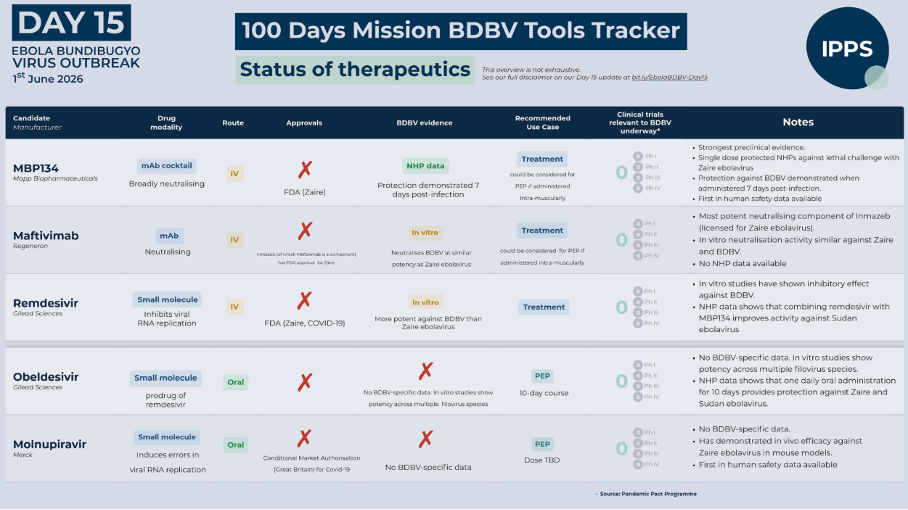
In practice, this means that companies are testing the activity of existing treatments for similar viruses as the fastest possible way to proceed, while in parallel seeking to accelerate the development of novel candidates. Several candidate treatments – including monoclonal antibodies and direct-acting antivirals – are being prioritized for clinical trials under WHO guidance. Lessons learned from rapid development during COVID-19 can potentially help speed up the trials, while ensuring rigour and quality is maintained. Another antiviral therapy will be tested for post-exposure prophylaxis.
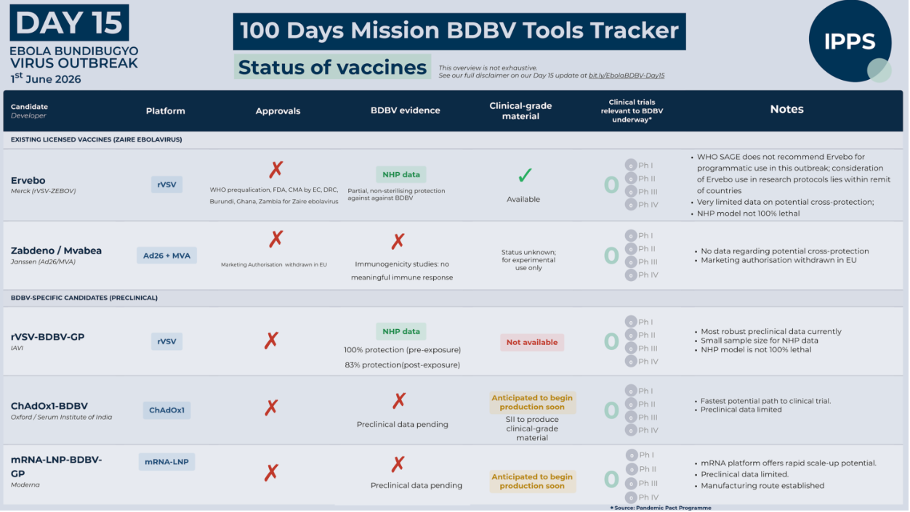
On vaccines, efforts focus both on evaluating whether licensed vaccines for different strains of Ebolavirus can offer cross-protection and on rapidly advancing new Bundibugyo strain-specific vaccine candidates. Multiple vaccine technology platforms are being taken forward, with clinical-grade material entering production and trials expected to begin soon – including mRNA and the ChAdOx1 platforms used to respond to COVID-19 as well as the rVSV platform.
Large pharmaceutical companies, vaccine companies from high- and low-income countries, biotechs, and academic researchers have all voluntarily contributed their technologies, capabilities, potential treatments, and vaccines and are working together with key global, regional, and local partners. These include CEPI, GAVI, Africa CDC, and relevant regulatory and preparedness authorities such as WHO, BARDA, EMA, and the European Commission, including HERA, to make progress as fast as possible. Partners are contributing what they can in terms of scientific expertise, logistical and practical support on the ground, clinical networks, and funding to enable end-to-end R&D, manufacturing scale-up, and coordinated outbreak response. Other companies have contributed funding, emergency medical supplies and PPE, and support for healthcare workers.
This response builds upon the strong track record of pharmaceutical companies voluntarily stepping up in response to health emergencies. During the previous ebolavirus Public Health Emergencies of International Concern (PHEICs), hundreds of thousands of vaccines were
donated to support preparedness and response against the Zaire strain of Ebolavirus in high-risk regions. In parallel, over 350,000 people were vaccinated before full licensure under compassionate use and outbreak protocols, supported by WHO-endorsed ring
vaccination strategies.
At the same time, outbreak response efforts also advanced the development and deployment of therapeutics targeting the Zaire strain, underscoring the complementary role of treatments in reducing mortality. The data generated in those outbreaks eventually led to
regulatory approvals and WHO pre-qualification and the first global vaccine stockpile against Zaire ebolavirus was created, alongside the establishment and donation of therapeutic stockpiles to support rapid treatment access in future outbreaks.
Preparing for the future
The current outbreak reinforces the need for strong preparedness systems, which must be in place before crises emerge and require sustained investment before and on an ongoing basis after outbreaks occur. Considering that only 10% of candidate drugs and vaccines that enter clinical development reach patients, recent data shows that many high-risk viruses lack sufficient R&D programs to provide the chance that the needed treatments and vaccines will be available in the future.
Investment in platform technologies and viral family approaches is also crucial in cases like Ebola. This allows tools to be adapted more quickly across different strains where no solutions may yet exist and achieve the goals of the 100 Day Mission. New public-private collaboration models and risk-sharing measures to attract and support more investment in R&D into emerging infectious diseases where outbreaks are sporadic and unpredictable are also critical.
The Ebola Bundibugyo outbreak serves as another reminder of why it is so important to safeguard the rapid and open pathogen and data sharing. Doing so allows scientists to work as quickly as possible on developing the medicines and vaccines needed to respond to future outbreaks. Effective responses require maintaining global stockpiles, alongside early and sustained financing and predictable demand signals; strengthening of regulatory collaboration and accelerated pathways; and sustainable investment in delivery systems, resilient supply chains, workforce, and infrastructure that ensure medicines and vaccines can get to the people who need them in a timely manner.
Note to the media
- INTREPID Alliance: Antiviral Clinical and Preclinical Development Landscape
- IPPS tracker for Ebola (Bundibugyo) Day 15: The Status of Diagnostics, Investigational Therapeutics and Vaccines
About BIO
BIO, the Biotechnology Innovation Organization, is the premier biotechnology trade association representing biotech companies, industry leaders, and state biotech associations in the United States and more than 35 countries around the globe. BIO members range from biotech start-ups to some of the world’s largest biopharmaceutical companies – all united by the same goal: to develop medical and scientific breakthroughs that prevent and fight disease, restore health, and improve patients’ lives.
For more information, visit https://www.bio.org/
About DCVMN
The Developing Countries Vaccine Manufacturers Network (DCVMN) is a voluntary, public health-driven alliance of vaccine manufacturers from developing countries, committed to protecting people against known and emerging infectious diseases by ensuring a consistent supply of high-quality, affordable vaccines and advancing vaccine equity worldwide.
For more information, visit https://dcvmn.org/
About IFPMA
IFPMA represents the innovative pharmaceutical industry at the international level, engaging in official relations with the United Nations and multilateral organizations. Our vision is to ensure that scientific progress translates into the next generation of medicines and vaccines that deliver a healthier future for people everywhere. To achieve this, we act as a trusted partner, bringing our members’ expertise to champion pharmaceutical innovation, drive policy that supports the research, development, and delivery of health technologies, and create sustainable solutions that advance global health.
For more information, visit ifpma.org
About Vaccines Europe
Vaccines Europe is a specialised vaccines group within the European Federation of Pharmaceutical Industries and Associations (EFPIA). It represents vaccine companies of all sizes operating in Europe, and currently includes all the major global innovative and research-based vaccine companies, including small and medium-sized enterprises. Their mission is to foster innovation and value recognition of lifecourse immunisation in Europe to protect people against evolving health challenges.
For more information, visit https://www.vaccineseurope.eu/